
New whitepaper highlights opportunities for a circular and digital textile value chain
The European textile industry is at a pivotal moment. With stricter legislation on the way, growing geopolitical pressure and an increasing demand for sustainability, the sector needs to transform faster than ever. In a new white paper, researcher and NewTexEco Data Orchestrator Francesco Sollitto, together with several colleagues, analyses the green and digital transition required to future-proof the textile, clothing, leather & footwear (TCLF) sector. His main message? Without data sharing, clear rules and fair taxation, a circular textile chain won’t happen.
“We’ve been talking about sustainability for years, but as long as we don’t share information, we have limited understanding of what’s happening in the chain,” says Sollitto, also a reseacrher and data orchestrator at the Amsterdam University of Applied Sciences. “And that includes the Netherlands, one of the most digitalised countries in the world. We still have limited knowledge about how much is produced, imported, and sold (both in kg or # of items) across the different textile product categories.”
Legislation as a driver of transparency
The whitepaper Systemic Value Chain Transformation outlines the impact of new European legislation, including the upcoming Digital Product Passport. This passport will require companies to disclose product information, from material composition to recyclability. According to Sollitto, this shouldn’t be viewed as a threat, but as an opportunity.
“Companies often think data sharing means exposing their secrets. But that’s rarely the case. It’s about sharing essential information that helps us work together more effectively — things like location, production volumes and material flows. We’re not asking for profit margins or CEO salaries.” Making this type of data accessible enables companies across the chain to align their processes, a crucial step for circular production, repair and recycling.
Digital opportunities
The whitepaper also shows that digitalisation benefits more than just policymakers.
- Businesses can plan more efficiently, localise production and make better use of residual streams.
- Regional and national policymakers gain the data they need to develop effective circular policies.
- Consumers can be matched with more sustainable products, just as algorithms already recommend content and generate ads today.
“If we use data intelligently, we can produce far more efficiently,” Sollitto explains. “It brings us closer to true on-demand production — a system where you only produce what’s needed, when it’s needed. That alone prevents enormous amounts of surplus.”
Tax rules are holding back circular progress
But the most significant barrier to a circular textile chain, says Sollitto, isn’t technology, but taxation (or incentive structure). “As long as repairs, second-hand clothing and recycling are taxed as if they’re standard linear production, circular entrepreneurs don’t stand a chance to thrive,” he argues. “Why do you pay 21% VAT on repair? Why does someone working in a second-hand shop pay nearly 50% income tax, while they’re contributing to restoring value rather than producing new items?”
The whitepaper points to similar incentive structures already used in other sectors, such as construction and food. Comparable models could also work in the textile industry. Sollitto also refers to a French proposal for a progressive Extended Producer Responsibility (EPR) system, which places higher costs on major polluters. “It’s politically sensitive, of course, so it is not quite happening yet. But if we don’t have the conversation, change will never come. We need policies that actively protect circular players, otherwise they’ll always struggle and eventually disappear.”
Striking numbers: more than €15 billion lost in ten years
One of the most noteworthy findings from the research is the economic imbalance caused by the textile trade. “In less than a decade, the Netherlands has lost more than €15 billion through the textile trade deficit,” Sollitto explains. “We import far more than we export. Almost everything we wear comes from Asia, while the textile we do produce here is mainly high-value technical textile intended for export.”
The European figures are equally startling: the EU imports more than it consumes and exports more than it produces. Materials enter the chain, but don’t return — a clear sign of systemic overproduction. “It’s frankly absurd,” says Sollitto. “There are around 35 kilos of textiles per person placed on the market each year, yet we only consume 26. And still, every year we import more than we use and export more than we produce. It’s a chaotic system nobody fully controls.”
The hidden price of ultra-cheap fashion
Another challenge — also mentioned in the whitepaper — is the rise of ultra-cheap platforms like Shein and Temu. By exploiting European exemption rules, these companies pay almost no import duties, keeping prices extremely low. “The ministry knows these platforms are bypassing the rules, but no one intervenes,” says Sollitto. “We have strict rules within the EU, but at the same time, a wide-open back door for China. It raises a fundamental question: what is the point of the EU, if fair trade isn’t enforced?”
Consumers continue to buy cheap clothing, even when they care about sustainability. “If a sustainable sweater costs fifty euros more than a fast-fashion alternative, people will choose the cheaper option — logically,” Sollitto says. “You can’t blame consumers. The problem lies in the system that allows such low prices in the first place.”
Protect the frontrunners
Despite the challenges, Sollitto remains (moderately) optimistic. He sees many Dutch startups and circular initiatives making a real impact: from organisations collecting and sorting textile waste to repair workshops and upcycling entrepreneurs. “These are the people building the future,” he says. “But if they face the same tax burden as traditional companies, they won’t survive. We need to protect them . Otherwise, in ten years we’ll be discussing yet another failed transition.”
The core message
A circular textile industry will only become a reality if Europe embraces three things:
- Data sharing as the foundation for collaboration
- Smart, fair fiscal rules that reward (local) circular players
- Clear and bold legislation that truly tackles overproduction
As Sollitto puts it: “We need to stop seeing each other as competitors and start working together. Transparency isn’t a threat — it’s the only way to build a resilient, future-proof textile chain in Europe.”
Related items
Francesco Sollitto
Fracesco Sollitto has a background in economics and statistics. Early in his academic and professional career, his focus shifted toward the sustainability domain and the value of digitalization. The interest in multi-stakeholder collaboration that he developed at the start of his career has shaped his thinking on how digital solutions can be used to accelerate […]

Systemic value chain transformation
This white paper provides a clear overview of the green and digital transformation of the European and Dutch TCLF sector. The paper outlines both opportunities and challenges, emphasising the importance of collaboration within the chain. It also shows how new legislation and data sharing, such as the Digital Product Passport, can contribute to more transparency in the production chain and a future-proof, circular system.
Project Updates
8 April 2026
Participate in research on sustainable textiles
The research team of Hogeschool van Amsterdam invites companies to participate in a new research project within NewTexEco: The Business Case for Durability: Collaborative Value Creation in Circular Textile Ecosystems (BUDUCE). The project investigates how collaborative models in circular textile chains create, deliver and retain value for all parties involved. Sustainability as a system driver […]
2 April 2026
Shape the Digital Product Passport for textiles
In addition to the Industry Living Lab workshop series, such as the one held on 13 April 2026, the Molecular Digital Physical Product Passport Project (M-DPP project) is conducting a Delphi Stakeholder Consultation – a structured, multi-stage process designed to form an informed picture of what Digital Product Passports actually require in practice within the […]

23 March 2026
Tax on cheap Chinese packages, a good idea?
A dress for five euros, play sand for a tenner, or a phone case that costs less than a cup of coffee. Chinese online shops are flooding Europe with spot-cheap products and that is not without consequences. The European Commission is therefore going to introduce a tax on cheap packages from outside the EU from […]
4 March 2026
Care & Repair in education and society
What happens when you put a washing machine in the middle of the central hall of ArtEZ University of the Arts and ask students and, later in the streets, shoppers about their clothing and washing habits? This 3-minute short doc makes Care & Repair‘ s research directly visible and approachable. In this short-doc, project leader […]

3 March 2026
Dutch people and their wardrobes: what the figures show
The transition to a circular textile system starts not only in design and production, but also in consumers’ wardrobes. This is according to recent research by Hogeschool Rotterdam, conducted in collaboration with several colleges and our research consortium NewTexEco. The study, based on the analysis of 958 wardrobes of Dutch people aged between 15 and […]
2 March 2026
Techtextil 2026: Netherlands as frontrunner in circular textiles
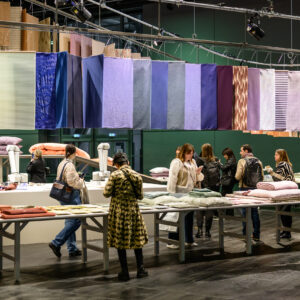
From 21 to 24 April, the Netherlands will present itself at Techtextil in Frankfurt with the pavilion ‘NL Circular Textile Solutions – Ready for Europe’. This will show that the Netherlands is an international leader in circular textiles and digital innovation. As a connecting research and innovation platform, we are proud that several partners from […]
17 February 2026
3D DutchMerino from Summer School soon to be in Zuiderzee Museum
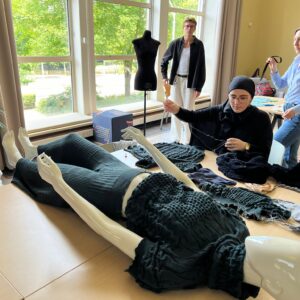
The results of the NewTexEco 3D Summer School Knitting 2025 will have a special sequel: the garments developed during the week will be on display at the Zuiderzee Museum in the autumn. This will give July’s intensive making and learning process a museum context and show how innovation, craft and material research come together. From […]
28 January 2026
New at Knit2Last: Maud Kuppen
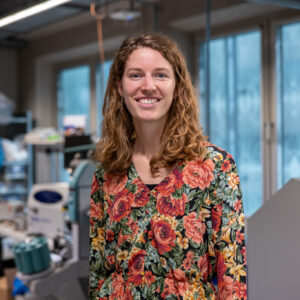
We would like to introduce Maud Kuppen , lecturer and researcher at Saxion University of Applied Sciences. Maud obtained her Master of Science in Innovative Textile Development and has been working within the Sustainable & Functional Textiles research group since 2020. Her work focuses on sustainability in the textile sector, with a special focus on […]

28 January 2026
New at Care & Repair: Nora Veerman
We are delighted to introduce Nora Veerman as the new project coordinator for the Care & Repair project. Nora brings a unique combination of fashion theory, hands-on experience, and a strong passion for collaboration. Nora is fascinated by the interplay between research and design. With a background in art history and fashion studies, as well […]

22 January 2026
New whitepaper highlights opportunities for a circular and digital textile value chain
The European textile industry is at a pivotal moment. With stricter legislation on the way, growing geopolitical pressure and an increasing demand for sustainability, the sector needs to transform faster than ever. In a new white paper, researcher and NewTexEco Data Orchestrator Francesco Sollitto, together with several colleagues, analyses the green and digital transition required […]

17 December 2025
Spotted! Publication on Care & Repair
The first projects within CLICKNL ‘s Design Power & Transitions programme have started. In the new interview series Ontwerpkracht Crossovers, writer Twan Eikelenboom brings project leaders together to talk about their first experiences in the research phase. The first publication focuses on the Care & Repair project. This project is part of both Design Power […]

25 November 2025
New at NewTexEco: Karen Bosch
We welcome Karen Bosch as education coordinator within NewTexEco. Karen is a lecturer-researcher at Saxion‘ s Fashion & Textile Technologies programme and brings with her a broad background in commercial economics, communication science, market research, marketing and sustainability-oriented education within several colleges, including AMFI. There, it became clear to her how urgent the challenges in […]

10 November 2025
From wool remnant to 3D knitted future
In the project Closing the Knitwear Loop, our partner New Industrial Order (N.I.O.) together with chain partners Knit-It (Knit Manufacturer), Stcreative (Digital Design), Favourite Forms (Sizing & Fit) and Marije Lytske Hester (Impact Research) show how innovation, digitisation and circularity reinforce each other. The jumpers shown below are 3D-knitted from fully recycled wool; wool that […]
10 November 2025
Students take the lead in clothing sustainability research
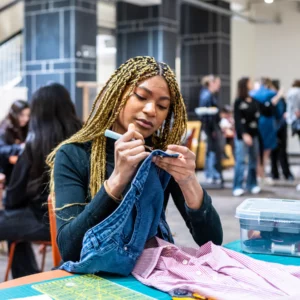
How do students handle their clothes? And what role does that play in the transition to a circular fashion sector? The Care & Repair research project of ArtEZ University of the Arts (ArtEZ) and the Hogeschool van Amsterdam (HvA) actively involves students in understanding and changing clothing use. How students wash, dry and care for […]
29 October 2025
Strong together at Dutch Design Week: a community on the move
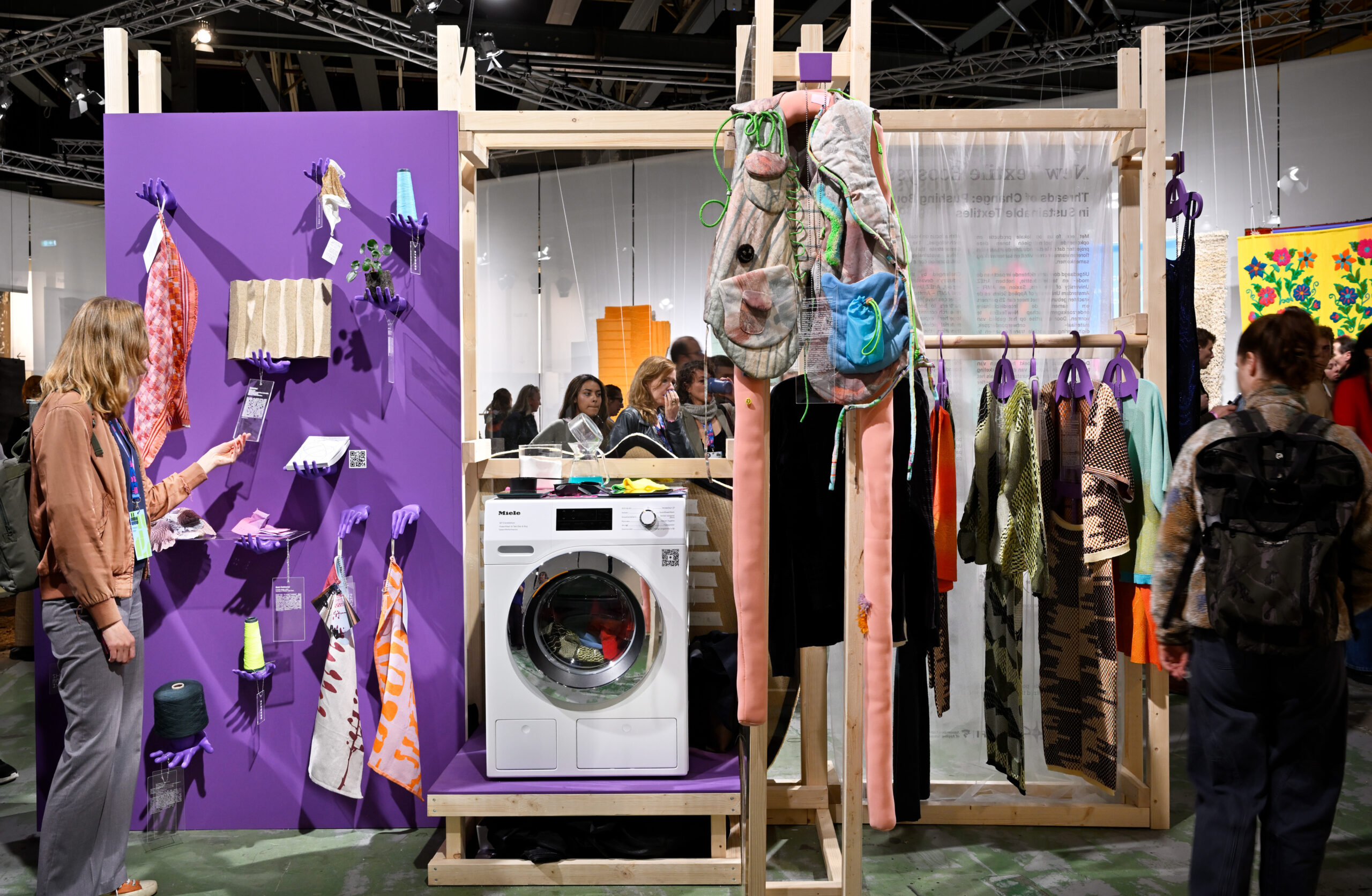
During Dutch Design Week, we as the NewTexEco community were literally and figuratively at the heart of the movement: in a prominent spot in the Klokgebouw building, we shared our vision of a sustainable, circular and regenerative textile sector. The interest was great and the discussions inspiring: together we showed how wide and lively the […]
21 October 2025
Between Technology and Tactility: a shared language for the textile sector
What happens when we treat textiles as data? Or when code itself becomes textiles?A recent interview for Seamless features two influential innovators exploring exactly that: Sandra Kuijpers ((Hogeschool van Amsterdam – FashionResearch & Technology / AMFI) and Troy Nachtigall (Hogeschool van Amsterdam – Fashion Research & Technology, member core – and programme team NewTexEco) Their […]

8 October 2025
About Lucie Huiskens: a pioneer who turned loose threads into a fabric
After 20 years of building cooperation and innovation in the fashion and textile sector, Lucie Huiskens, programme coordinator of NewTexEco, is bidding farewell to her working life at ArtEZ University of the Arts. And she is doing so in style. During Dutch Design Week, she will launch her e-magazine From loose threads to fabric. A […]

7 October 2025
A Dutch Design Week Textile Guide
From 18-26 October, Eindhoven is once again the scene of Dutch Design Week, with textile traditionally playing a big role. With work by more than 2,600 designers, sometimes you can’t see the wood for the trees. That is why NewTexEco, together with partner Modint, has compiled the Dutch Design Week Textile Guide . It contains […]
15 September 2025
Retrospective Circular Textile Days
The Circular Textile Days is a business event that provides an excellent opportunity to meet new partners within the sustainable textile sector and to discover and discuss innovative circular textile solutions. We also attended, with network manager Floor van der Holst as our point of contact. This 5th edition brought together over 90 companies from […]

15 September 2025
Meet us @ Dutch Design Week
Dutch Design Week celebrates a quarter-century of shaping the future. Under the theme Past. Present. Possible. DDW looks back on its legacy, showcases today’s creative energy and explores what design can become. A platform where ideas come together, possibilities open up and the future is shaped together. Of course we will be present! Our programme: […]