Knit2Last: from waste to innovation
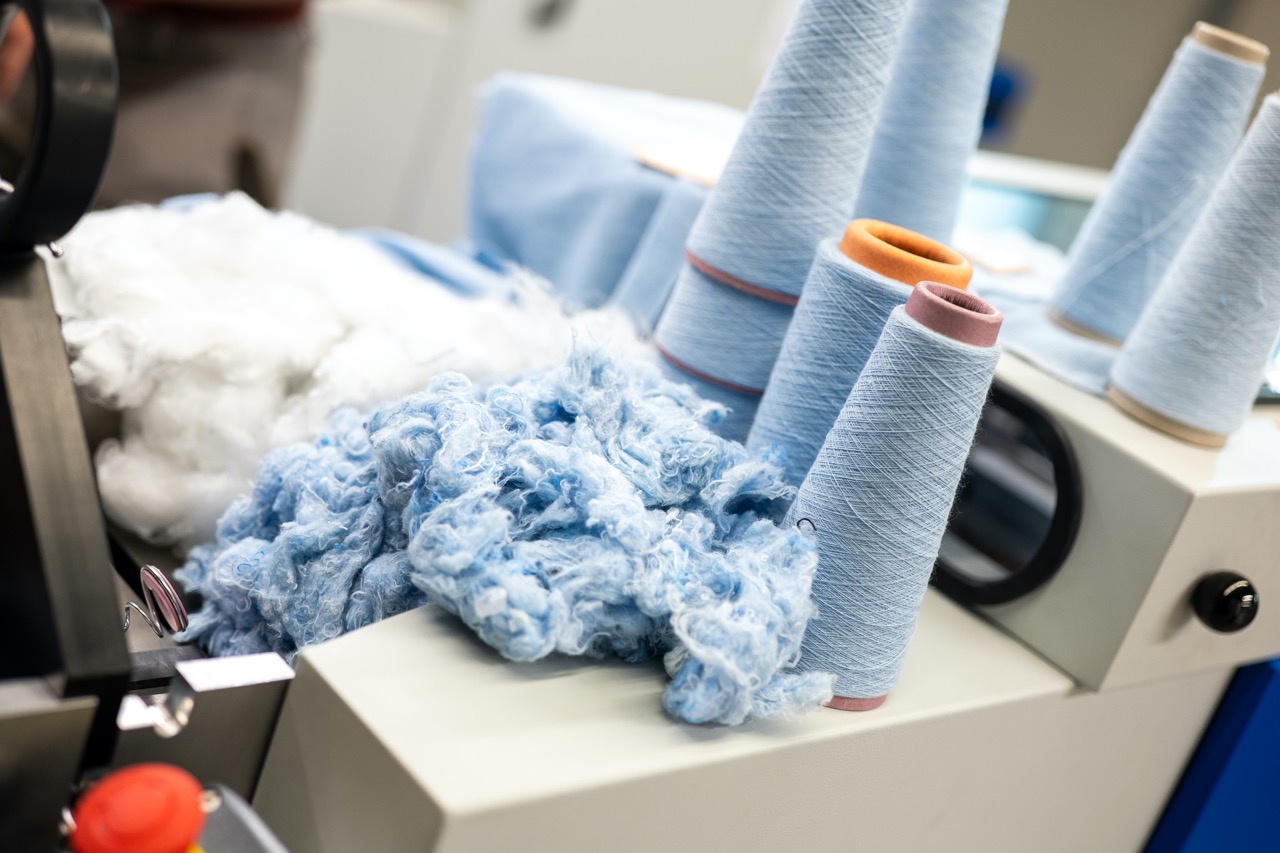
In this KIEM project, we investigate the properties of products made with recycled fibres. For this purpose, wool fibres from both pre- and post-consumer clothing are reused via mechanical recycling, providing insight into the material’s processability and the performance of the knit. This allows accurate prediction of garment properties even before knitting.
Recycling and processing pre- and post-consumer residual streams remains a challenge, as the quality of recycled fibres often degrades and high-quality reuse is difficult. Using Knit2Last, we focus specifically on the reuse of wool in knitted products, a material that is often not yet included in recycling processes. By reusing high-quality materials in high-quality products and accurately measuring their impact with LCA calculations, we can properly compare the circular process with the conventional process.
Reason
Wool recycling is still hardly applied in practice, even though it is by nature a high-grade material and reuse in production processes is not yet a norm due to complex material properties. This research responds to that issue and contributes to more sustainable and efficient ways of reusing wool within the textile industry.
Objective
The main objective of this project is to recycle wool from post- and pre-consumer residual streams and process it into high-quality products, while being able to predict the processability of recycled materials.
The main question of this research is: how can the mechanical properties of knitted fabrics from recycled wool be improved by process engineering, what is the ecological impact of this optimisation, and how can the data obtained contribute to further digitisation?
Approach/methodology
The project is divided into five different work packages. The first phase investigates what knowledge is already available and how it can be used effectively within the project. Next, the research focuses on the practical possibilities for recycling wool. It will then look at whether the recycled material is suitable for spinning yarns and how these yarns can be further optimised. The ultimate goal is to knit with the developed yarns and assess the quality of the knit. In parallel, a detailed LCA will be prepared, comparing the recycled material flow with the conventional flow.
Role of partners
By linking the high-quality textile materials of New Industrial Order (NewTexEco partner and an Amsterdam innovation collective) to Saxion’s laboratories and testing facilities, advanced techniques are being developed for fibre processing, spinning, knitting and testing. This will allow the mechanical properties of recycled knitwear to be accurately characterised and optimised.Thanks to the expertise of Life Cycle Assessment (LCA) researcher Natascha van der Velden (NvdV) in sustainable textiles, the translation is made into practical, scalable solutions for industry. Knit2Last translates research into concrete solutions that make textile production structurally sustainable.
Results and impact
Knit2Last is an innovative step towards circular and smart knitwear production. The project shows how wool waste streams from the textile industry can be recycled into high-quality knitwear, using data to predict the processability and performance of recycled materials. This makes the production process smarter, more efficient and creates less waste. By combining high-performance recycling with digital production techniques, Knit2Last reduces reliance on virgin wool and contributes to a more sustainable, future-proof textile industry with minimal environmental impact.
NewTexEco
Knit2Last is part of the broad NewTexEco community of ArtEZ University of the Arts. In it, Saxion works together with ArtEZ, Amsterdam University of Applied Sciences and some 30 partners on the transition to a circular textile chain, with design as the driving force.
Sponsor: Saxion, research centre Sustainable & Functional Textiles
Project leaders: Floor van der Holst, researcher Sustainable Textiles at Saxion and network coordinator at NewTexEco
Partners: Lectorate Sustainable & Functional Textiles, New Industrial Order and Natascha van der Velden
Funding: KIEM HighTech 2025 grant
Started in: September 2025
Completed in: August 2026
Project-updates

28 January 2026
New at Knit2Last: Maud Kuppen
We would like to introduce Maud Kuppen , lecturer and researcher at Saxion University of Applied Sciences. Maud obtained her Master of Science in Innovative Textile Development and has been working within the Sustainable & Functional Textiles research group since 2020. Her work focuses on sustainability in the textile sector, with a special focus on […]
3 September 2025
Launch Knit2Last: from waste to innovation
Knit2Last is an innovative step towards circular and smart knitwear production made possible by the KIEM HighTech 2025 grant. The textile industry is among the biggest environmental polluters worldwide. Large waste streams are created during production, while discarded textiles have limited circular recycling. Our NewTexEco partner New Industrial Order (N.I.O.) is developing smart, local on-demand […]