(Un)seen labour
(Un)seen Labour is a research project by ArtEZ University of the Arts in collaboration with State of Fashion, and is conducted with partners Avans Hogeschool(Centre of Expertise Brede Welvaart and New Entrepreneurship) and Crafts Council Netherlands. Together, they explore how art and design can show what lies behind the fashion and textile industry. Through a circular and social approach, new ways of working emerge that contribute to more sustainable and equitable design practices.
Fashion and textile designers are keen to contribute to a circular transition, but need more knowledge about circular manufacturing and design methods. Production chains are long, complex and opaque, leaving much work ‘unseen’. This invisibility makes the transition to a circular and socially just fashion system more difficult. The project therefore focuses on questions such as: who are these unseen players in the chain? What do we mean by hidden labour, and which aspect(s) do we want to make visible in order to achieve more circular practices? In the first exploratory phase, the researching designers are given space to map this out.
Approach/methodology
Designers will engage with practitioners, researchers and other parties, exploring how circular working and design practices can emerge that are both socio-culturally and ecologically sound.
Participating designers are given the freedom to decide which aspect(s) of unseen labour they want to make visible. The result can take various forms: from a publication to a new tool or methodology. What is important here is that the process leads to more insight into circular work and that the entire ecosystem is included, because circularity is not only about material flows, but also about social and cultural dimensions.
Partners like NewTexEco play a role by connecting their partners and expertise to the project. They can offer insights into where invisible labour takes place. In turn, they benefit from the knowledge and methods developed in the project.
Results and impact
The project showcases the invisible contributions of artisans, repairers and consumers, and explores how they can be made visible. Designers develop practices that encourage transparency, inclusiveness and sustainability in the fashion industry. The first concrete results will be visible at the 2026 State of Fashion Biennale in Arnhem, where the project will be presented in the form of an exhibition and symposium. That is phase one. The following year, a second moment will follow, during which the collaboration with NewTexEco will take centre stage and the developed knowledge will be further shared.
Project management
As main contractor, ArtEZ University of the Arts is responsible for project management. The project is led by Prof Daniëlle Bruggeman and Catelijne de Muijnck (ArtEZ Fashion Department) in close cooperation with Iris Ruisch (director State of Fashion). They work together with the work package leaders and are responsible for the content management, quality and progress of the project, as well as for the dissemination of the knowledge and results developed.
NewTexEco
(Un)seen labour is part of the broad NewTexEco community of ArtEZ University of the Arts. In it, Saxion works together with ArtEZ, Amsterdam University of Applied Sciences and some 30 partners on the transition to a circular textile chain, with design as the driving force.
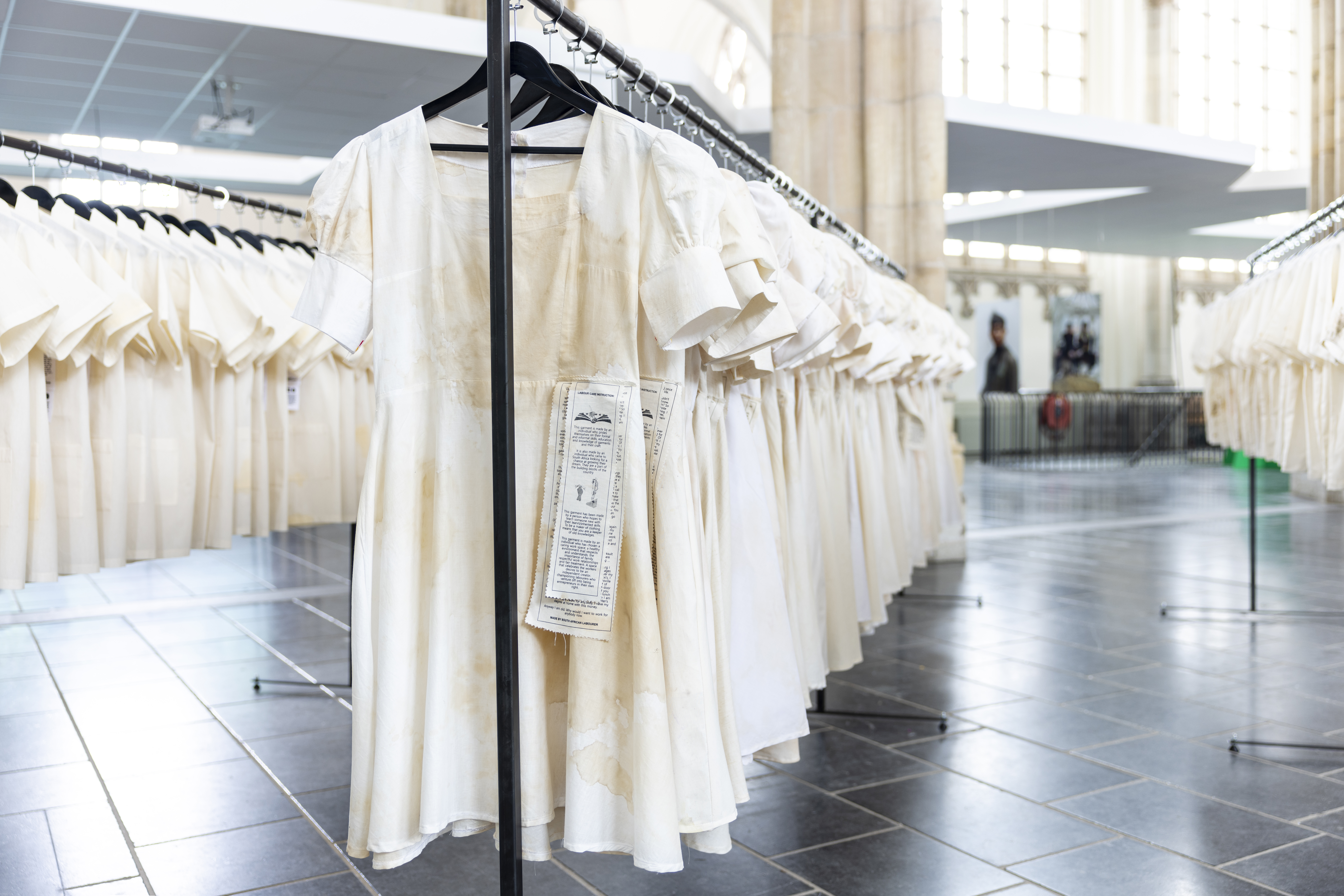
Image: installation bodies that make, bodies that consume by Santiago Útima, Siviwe James, Widi Asari & Riyadhus Shalihin